


10th

Oklahoma Film Critics Circle Honors Sterlin Harjo With Award for Achievement in Film
The Oklahoma Film Critics Circle has honored filmmaker Sterlin Harjo with the 2011 Tilghman Award celebrating achievement in cinema in the state.
The OFCC presented Harjo with the Tilghman Award Friday, Nov. 5, after a screening of several of his most recent works, documentary shorts for Tulsa’s This Land Press. The event was at the Oklahoma City Museum of Art.
Harjo, a 31-year-old member of the Seminole and Creek Nations, has earned international acclaim for films examining contemporary life of Native people. His feature-length narratives – “Four Sheets to the Wind” in 2007 and “Barking Water” in 2009 – are emotionally rich motion pictures populated by complex characters.
“Sterlin’s films are invested with a humanity and depth of emotion that eludes many of his older, more experienced peers,” says OFCC President Rod Lott. “In a short period of time, Sterlin has really raised the bar for Oklahoma filmmakers. He more than deserves the Tilghman for his commitment to his art.”
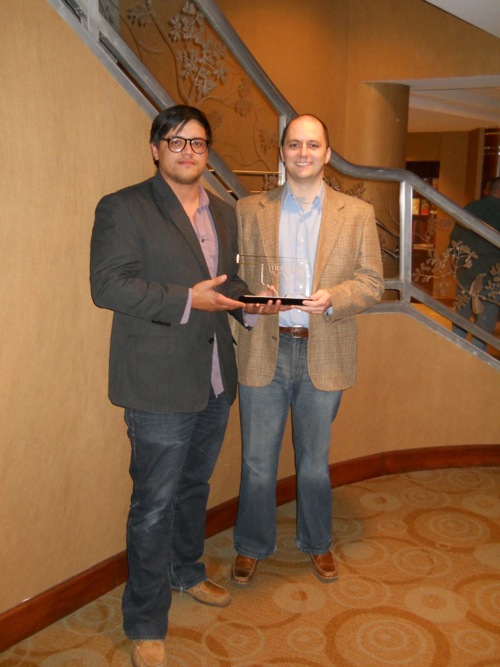
Sterlin Harjo receives the Tilghman Award from OFCC president Rod Lott
OFCC’s 19 member critics choose as recipients of the award those individuals who have made significant contributions to film, advanced awareness of film in Oklahoma or highlighted Oklahoma as the home of talented and productive filmmakers, actors and others in the industry.
Raised in Holdenville and now living in Tulsa, Harjo began his filmmaking career while he was an art student at the University of Oklahoma. He credits a film class of Misha Nedeljkovich there with introducing him to the motion pictures of John Cassavetes and other independent-minded directors.
“It really opened my eyes to foreign films and independent films,” Harjo says. “He (Nedeljkovich) introduced me to all these different filmmakers and … the fact that you could make your own kind of film and it didn’t have to be like the stuff you see coming out of Hollywood.”
After launching into film, Harjo was selected to the Sundance Institute Filmmaker Lab. There he met producer Chad Burris, a Weatherford native, and the pair collaborated on a short film, “Goodnight Irene,” before tackling a larger project based on Harjo’s screenplay.
That resulting work, “Four Sheets to the Wind,” premiered at the 2007 Sundance Film Festival. The film tells the story of a young man named Cufe Smallhill (Cody Lightning) who goes to live with his troubled sister after the death of their father. The movie drew strong critical acclaim and earned a Sundance Special Jury Prize for Tamara Podemski, who portrayed Cufe’s sister. The actress later earned an Independent Spirit Award nomination for her performance.
In 2009, Harjo wrote and directed “Barking Water,” a haunting road film about a dying man and his ex-lover traveling across Oklahoma to visit the man’s estranged son. The movie also premiered at Sundance and has been screened around the world.
“I just don’t see myself making films about any other place,” Harjo says. “I mainly tell stories about contemporary Native people from specific tribes — usually Seminole and Creek — and the history of those tribes are that they were displaced from their homeland and put in Oklahoma. There’s a whole dynamic there that’s already created; it’s already complex, and it’s already going to influence my storytelling.”
Previous Tilghman Award recipients are documentary filmmaker Bradley Beeseley, Oklahoma City Museum of Art film curator Brian Hearn and Circle Cinema Foundation president Clark Wiens.
The Tilghman Award is named for William Matthew “Bill” Tilghman, widely credited with being the first individual to make a feature-length movie in what is now Oklahoma. He served as a deputy U.S. marshal and police chief in Oklahoma City, among other law-related positions. Tilghman also served as a state senator. In 1908, he made “A Bank Robbery,” which starred real-life bank robber Al Jennings recreating one of his crimes.
It was the first of several films Tilghman set in the state. In 1915, the lawman-turned-filmmaker made “Passing of the Oklahoma Outlaws,” again starring actual criminals and the good guys who chased them. He is known for his attempts to deglamorize the outlaw villain and for striving to prove there are no outlaw heroes.
